

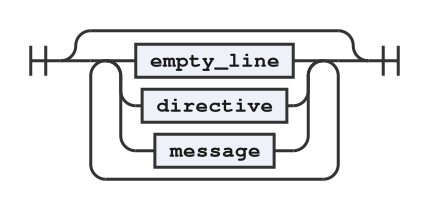
A message file is plain text, read line by line. Every line is one of three things:
- an empty line — blanks, a
#comment, or nothing; - a directive — a
$followed by a keyword:$MODULE,$LANGUAGE,$STRING, …; - a line that belongs to the message above it — a parameter, a language header or a text line.
# greetings.msg — a complete message file
$MODULE greetings
$NAMESPACE app
$LANGUAGE en
$STRING ENABLE

$MESSAGE Welcome
@ user std::string const &
"Welcome, {$user}!"
[tr]
"Hoş geldin, {$user}!"
$MESSAGE Welcome opens a message; the @ line declares its parameter; the quoted lines are its text in English and — after the [tr] header — in Turkish. The next directive, or the end of the file, closes it.
Keywords and case
Directive and option keywords are case-insensitive: $MESSAGE, $message and $Message are the same, and so are ENABLE and enable. Everything you name — messages, parameters, classes, namespaces — keeps its case, because it becomes C++.
Where to go next
| Construct | Page | |
|---|---|---|
| blank lines, comments, line ends | Lines & Comments | |
$MODULE, $NAMESPACE, $INCLUDE, $IMPORT, $USING, $EXPORT, $LANGUAGE | Directives | |
$STRING, $STREAMABLE, $ERROR, $EXCEPTION, $THROW, $SYSLOG | Artefact Directives | |
$MESSAGE, @, [language], '…', "…", `\ | …` | Messages |
| identifiers, qualified names, language names | Names | |
| every rule on one page | Grammar summary |
These pages are the syntax. What each directive does, and the C++ it produces, is the Reference Manual.


