

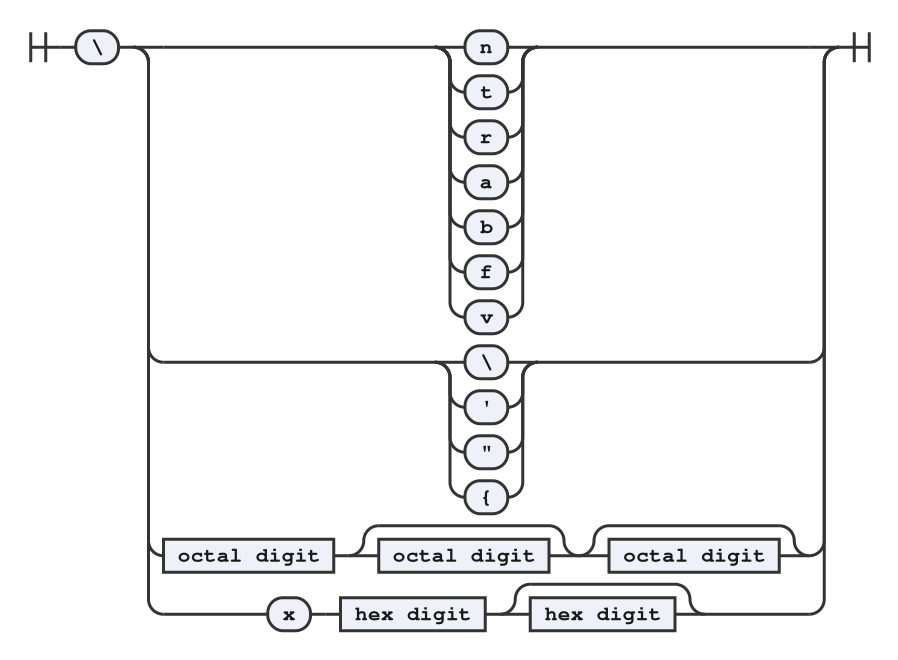
| Escape | Character |
|---|---|
\n \t \r \a \b \f \v | the control character |
| a doubled backslash | one backslash |
| backslash + single or double quote | that quote |
\{ | a literal { — \{$x} is not a macro |
\303 (1–3 octal digits) | that byte |
\xC3 (1–2 hex digits) | that byte |
| a backslash before anything else | the backslash itself |
The last rule keeps paths readable: 'C:\data' is C:\data.
Escapes work in all three text line forms. Inside a macro, a backslash makes the next character literal (\;, \}).


